


 Warranty Policy
 FAQ
FAQ Download
 Company Events
 Business Events
 Vlog
Vlog Profile
 Why Premteco
 Certificates

 CN
CN EN
EN RU
RU ES
ES AR
AR

High-grade XR LED display-P1.9, P2.6, P2.9

Indoor Small Pitch Mini LED Display-P0.9, P1.25, P1.56

LED Floor Display-P2.5, P2.6, P2.9, P3.9, P4.8,P5.2,P6.25

Extremely Thin 4k LED Display

Fine Pitch LED Display-P2.5, P2, P1.8

Interactive LED Display-P1.2, P1.5, P1.8

Indoor Fine Pitch LED Display-P1.86, P2.0, P2.5, P3.076

Indoor Fine Pitch LED Display

Innovative COB LED Display - P0.78 P0.93 P1.25 P1.56 P1.87

Innovative 4K COB LED Display

Indoor Fine Pitch COB LED Display

Macro High Definition COB LED Display

Indoor Fine Pitch LED Display P0.7, P0.9, P1.25, and P1.56

IP68 Outdoor Front Access LED Display

Outdoor Front Service LED Display-P5, P6, P6.6, P8, P10

IP68 Outdoor Front Service LED Display-P6, P8, P10

Indoor Fully Front Service LED Display - P1.9, P2.6, P2.9, P3.9

Outdoor Front Access LED Display-P4.7, P6.3, P9.5

Outdoor LED Display Screen-P3.9, P4.8, P6.2, P7.8, P10.4

DIP LED Display-P10, P16, P20

SMD Outdoor LED Display-P1.9, P2.6, P3, P4, P6, P8, P10

Die-casting Slim Type Outdoor LED Display-P4, P5, P6.6, P8, P10, P16

IP66 Outdoor Front and Rear Access LED Display

Outdoor Front and Rear Access LED Display P5.71, P6.67, P8 and P10

Cutting-edge Outdoor LED Display Technology Solution

Outdoor Rental LED Display-P2.9, P3.9, P4.8

Outdoor Rental LED Display-P3.9, P4.8, P5.9

High-quality Outdoor Rental LED display-P2.6, P2.9, P3.9, P4.8

Outdoor Rental LED Display-P3.9, P4.8, P5.9

Outdoor Rental LED Display-P2.9, P3.9, P4.8

High Quality Outdoor Rental Transparent LED Display

High Quality Outdoor Rental Transparent LED Display

Indoor LED Display-P2.5, P3, P4, P5

Indoor LED Panel for Rental-P2.6, P2.9, P3.9, P4.8

Indoor LED Panel for Rental-P2.6, P2.9, P3.9

Indoor LED Panel for Rental-P2.6, P2.9, P3.9

Indoor LED Panel for Rental-P2.6, P2.9, P3.9, P4.8

LED Curtain Display-P10.4, P12.5, P15.6, P25, P31.2

Media Facade LED Display-P12, P15, P25, P31, P50

Translucent LED Display-P1.9, P2.8, P3.9, P7.8, P10


Outdoor LED Display Banner-P2, P3, P4, P5

Indoor LED Display Banner-P1.8,P2.5

Indoor LED Display Banner-P1.8,P2.5

Shelf LED Display for Supermarket and Retail Stores


Spherical LED Screen for Indoor and Outdoor Advertising

Oct. 08, 2026< Back to list
Both Traditional and Flip-Chip COB are marketed as high-density, highly protective LED packaging solutions. On a spec sheet, they often look nearly identical—sharing similar pixel pitch, brightness, and cabinet dimensions. Yet in the field, their performance, thermal behavior, and operational costs can diverge significantly.
That is because "COB" defines a packaging philosophy, not a single hardware standard.
The distinction lies in how the chips are mounted and connected. Wire bonded or wireless, this fundamental choice dictates heat dissipation, optical uniformity, long-term reliability, and repairability.
For integrators and procurement teams, the real decision isn't just whether Flip-Chip COB is newer or more advanced. It is whether its underlying architecture provides a measurable advantage for the specific application, operating conditions, and maintenance strategy of the project.
1. The Differences Between Wire-Bond COB and Flip-Chip COB
The fundamental difference between wire-bond and Flip-Chip COB lies in how the LED chip is mounted and electrically connected to the substrate.
In wire-bond COB, the chip is mounted active-side up and connected through bonding wires. Flip-Chip COB reverses the chip orientation, placing its electrical contacts downward and connecting them directly to the substrate through conductive bumps or similar structures.
By eliminating the conventional wire-bonding path, Flip-Chip changes the internal connection architecture, which can influence thermal, electrical, mechanical, and reliability performance.
| Factor | Wire-Bond COB | Flip-Chip COB |
|---|---|---|
| Chip connection | Typically wire bonded | Direct flip-chip connection |
| Electrical path | Includes bonding wires | Shorter direct connection |
| Heat path | Depends strongly on package / substrate design | Can provide a more direct thermal path |
| Surface protection | COB encapsulation | COB encapsulation |
| Mechanical robustness | Generally strong | Potentially stronger at chip connection level |
| Fine-pitch potential | Excellent | Excellent |
| Manufacturing complexity | Relatively mature | More demanding process |
| Typical cost | Lower | Higher |
However, packaging structure alone does not determine final display performance. Driver ICs, PCB/substrate materials, LED chip quality, encapsulation material, calibration, thermal design, and manufacturing quality all remain important.
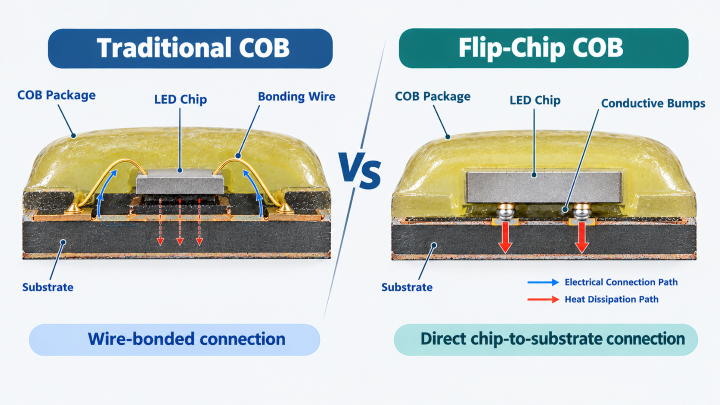
2. How the Packaging Structure Affects LED Display Performance
Wire-bond COB and Flip-Chip COB differ not only in how LED chips are mounted, but also in how chips connect to the substrate. These structural differences can influence electrical stability, heat dissipation, and mechanical reliability. However, packaging is only one part of the display system, so its advantages should be evaluated together with the driver IC, PCB, calibration, and cabinet design.
2.1 Low-Gray Performance
Low-gray performance is critical for video, broadcast, virtual production, and premium commercial displays. Flip-Chip eliminates conventional wire bonding and provides a more direct chip connection, which can support stable electrical performance.
However, wire-bond COB does not automatically mean poorer grayscale performance. Driver ICs, PWM, scan mode, LED consistency, calibration, and power stability also play major roles.
In practice, Flip-Chip may provide a favorable electrical foundation, but low-gray image quality remains a system-level result. Buyers should evaluate near-black gradients, shadow details, and dark-color content rather than relying solely on specifications such as “16-bit grayscale.”
2.2 Color Consistency
COB packaging integrates LED chips into a unified encapsulated structure, helping create a more consistent optical surface than individual SMD packages. Flip-Chip further uses a compact chip-to-substrate connection, which can support pixel-level consistency when manufacturing is well controlled.
However, packaging alone cannot guarantee uniform color. Pixel-to-pixel consistency, module-to-module uniformity, white balance, calibration, and long-term color stability should all be evaluated—especially for large LED walls assembled from hundreds of modules.
2.3 Thermal Performance
Thermal management is one of Flip-Chip's clearest structural advantages. By eliminating conventional bonding wires and providing a more direct chip-to-substrate connection, Flip-Chip can create a shorter and potentially more efficient thermal path.
This can benefit high-brightness, long-running, high-temperature, and outdoor applications.
However, actual thermal performance also depends on the substrate, PCB, driver IC, power supply, cabinet design, and ventilation. Buyers should compare measured thermal data under the same operating conditions rather than assume Flip-Chip always runs cooler.
2.4 Mechanical Reliability
For rental and touring displays, repeated transportation, installation, and handling place additional stress on the LED package. Wire-bond COB uses bonding wires as internal electrical connections, while Flip-Chip removes these conventional wire bonds and therefore eliminates one potential interconnection vulnerability.
This can be advantageous for frequently transported or repeatedly assembled displays. Nevertheless, overall mechanical reliability also depends on cabinet rigidity, module fixation, connectors, PCB design, encapsulation, and protective structures.
2.5 What the Packaging Difference Really Means
| Performance Area | Wire-Bond COB | Flip-Chip COB | What Buyers Should Evaluate |
|---|---|---|---|
| Electrical connection | Wire-bonded | Direct chip connection | Current consistency and electrical stability |
| Low-gray performance | Strongly system-dependent | Potentially favorable electrical structure | Actual low-gray image quality |
| Color consistency | Good with controlled manufacturing | Potential for improved pixel-level consistency | Batch and module uniformity |
| Thermal path | Depends on package and substrate design | More direct chip-to-substrate path | Measured thermal performance |
| Mechanical reliability | Includes bonding-wire connections | No conventional bonding wires | Reliability under transport and handling |
| System-level performance | Strong when well engineered | Strong when well engineered | Complete display design |
The key takeaway: Flip-Chip COB offers specific structural advantages, particularly in electrical and thermal pathways, but it is not automatically superior in every performance category. The right choice depends on whether those advantages create measurable value for the intended application.
3. What the Difference Means for Maintenance
Packaging structure directly affects how damaged LED pixels can be repaired.
Wire-bond COB uses thin bonding wires to connect chips to the substrate, creating potential wire-related failure points. Flip-Chip eliminates bonding wires, removing these risks, but chip-level repair still requires specialized tools and expertise.
Therefore, Flip-Chip is not necessarily easier to repair. The key question for buyers is what can be repaired on site and what requires module replacement.
Before buying, ask the manufacturer:
(1) Is pixel-level repair supported?
(2) What tools and equipment are required?
(3) Can modules be repaired on site?
(4) Are factory-calibrated replacement modules available?
4. What Rental LED Display Companies Should Consider?
Rental companies have a different cost structure from fixed-installation buyers.
Their displays may be transported hundreds of kilometers, assembled repeatedly, exposed to different venues, and handled by different installation crews.
In this environment, reliability is closely connected to revenue.
4.1 Transportation and Handling
Rental cabinets face mechanical stress that fixed installations rarely encounter. Repeated loading, unloading, stacking, transportation, vibration, and accidental impacts can affect modules, connectors, cabinet frames, and LED packages over time.
COB can offer an advantage through its more protected encapsulated LED surface, but overall durability depends on the complete cabinet design. Buyers should evaluate corner protection, module fixation, locking mechanisms, connector durability, frame strength, and surface protection, especially during stacking and transportation.
4.2 Frequent Assembly and Disassembly
A rental display may be assembled and dismantled dozens or even hundreds of times during its service life, making repeatability more important than laboratory performance.
The cabinet should support fast assembly, accurate alignment, secure locking, quick module replacement, and easy screen reconfiguration. Flip-Chip COB may offer advantages in chip-level mechanical robustness, but the entire cabinet must be designed to withstand repeated handling.
4.3 Operational Reliability
For rental companies, downtime has a direct financial cost. A failure during a major event can lead to emergency technician and replacement equipment costs, additional transportation expenses, contract penalties, and loss of customer confidence. Therefore, reliability should be evaluated per operating cycle, not only under static installation conditions.
When evaluating suppliers, ask whether the product has been tested for vibration, mechanical impact, thermal cycling, humidity, aging, and repeated assembly and disassembly.
5. When Flip-Chip COB Makes More Sense
Flip-Chip COB becomes more attractive when the project places a high value on:
5.1 Long operating hours
Displays operating continuously or for extended periods can benefit from stronger thermal management and robust packaging.
5.2 High pixel density
Premium fine-pitch applications can justify investing more in packaging technology because the display is expected to deliver high image quality from a relatively short viewing distance.
5.3 Frequent transportation
Rental and touring applications place greater mechanical demands on LED modules.
5.4 High cost of downtime
For broadcast, corporate, premium retail, command centers, and major events, downtime can cost significantly more than the original price difference between two displays.
5.5 Long service life
If the display is expected to remain in operation for many years, improvements in reliability and thermal behavior can have greater economic value.
6. When Wire-Bond COB May Still Be Enough
Wire-bond COB should not be viewed as an inferior option.
A well-engineered wire-bond COB display can be an excellent choice when:
(1) The display operates in a relatively controlled environment.
(2) Transportation and handling are limited.
(3) Pixel density requirements are moderate.
(4) The application does not require extremely demanding thermal performance.
(5) Budget constraints are significant.
(6) The supplier has strong quality control and after-sales support.
For many fixed indoor installations, paying a substantial premium for Flip-Chip may provide limited practical benefit if both products already meet the project's required performance and reliability targets.
7. Compare Total Cost of Ownership Instead of Purchase Price
The key question for procurement teams is not initial price, but total cost of ownership (TCO).
A Flip-Chip COB display may cost 10–20% more initially, but fewer failures, lower maintenance, or longer service life may justify the premium.
Conversely, if it provides little measurable benefit, the premium simply increases capital expenditure.
A useful TCO model should include:
Purchase price + installation + transportation + electricity + spare parts + maintenance + downtime + replacement
For rental companies, also consider:
Rental cycles × revenue per event × downtime risk
This provides a more meaningful comparison than FOB price alone.
8. Wire-Bond COB or Flip-Chip COB for Your Project?
Neither technology is inherently superior; the best choice is dictated entirely by project specifications.
Wire-bond COB can provide a strong balance of image quality, surface protection, reliability, and cost. For many fixed indoor installations, it may already deliver everything the project needs.
Flip-Chip COB becomes more compelling when the application demands higher mechanical robustness, demanding thermal performance, high pixel density, long operating hours, frequent transportation, or minimal tolerance for downtime.
For integrators and procurement teams, the most reliable approach is to compare both technologies against the actual project requirements:
| Project Requirement | Wire-Bond COB | Flip-Chip COB |
|---|---|---|
| Cost-sensitive indoor installation | ★★★★★ | ★★★ |
| Premium fine-pitch video wall | ★★★★ | ★★★★★ |
| Long operating hours | ★★★★ | ★★★★★ |
| Frequent rental use | ★★★★ | ★★★★★ |
| Frequent transportation | ★★★★ | ★★★★★ |
| High downtime cost | ★★★★ | ★★★★★ |
| Controlled indoor environment | ★★★★★ | ★★★★ |
| Long-term reliability priority | ★★★★ | ★★★★★ |
9. Need Help Choosing the Right COB Technology?
Not sure which COB solution fits your project? The Premteco team can help you compare key specifications and TCO based on your application.
Contact Premteco to discuss your requirements and get a tailored COB LED display solution.
Control Room LED Video Walls: How to Choose the Right Display
Flexible LED Displays: Applications and Buying Guide
LED Display Grayscale: Bit Depth and Image Quality Explained
How to Choose an Outdoor LED Billboard: Pixel Pitch, Brightness, IP Rating and Power Consumption
COB vs MIP for P0.9 LED Video Wall: Which Is Better?
Premteco: special-shaped screen to present a different
How does the LED display follow the 5G trend?
Premteco introduces new design rental screen
Premteco P8 Perimeter LED Screen for Stadium in Canada
Premteco P10 Outdoor Fixed LED Display in Australia
Premteco P1.5 Indoor Full Color LED Screen in Australia
Premteco P8 Outdoor LED Trailer Screen in Australia
Premteco P2.5 Indoor LED Banner Screen in Australia
Premteco P4.8 outdoor LED screen in Qatar
Premteco P1.9 Indoor HD LED screen in Kuwait
Premteco P3.9 Outdoor Rental LED Display in Austria